


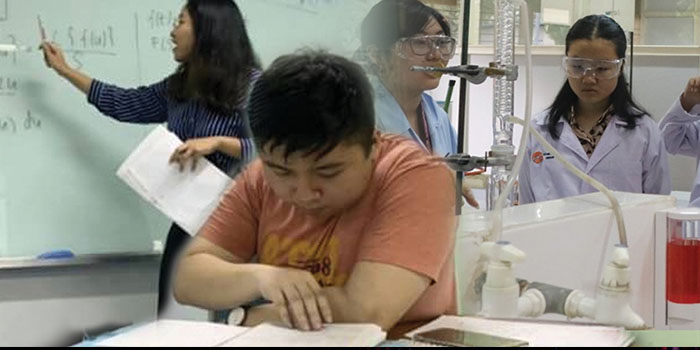
STEAM (Science, Technology, Engineering, Arts, and Mathematics)-based education is currently being developed as an alternative learning method at various levels of education.
This learning method requires students to actively participate in analysis and experimentation to achieve the desired level of understanding. This approach is particularly effective when applied to various fields of study, from basic sciences like physics and mathematics to informatics. Furthermore, science and technology are crucial elements of today’s global development, which continues to move toward digitalization.
Parahyangan Catholic University (Unpar) fully understands the importance of research-based learning. Scientific development at the Faculty of Information Technology and Science (FTIS) is not only based on theory, but also on research, observation, and real-world application. Through three study programs: Mathematics, Physics, and Informatics, with their respective concentrations, FTIS Unpar prepares young people to study and utilize science and technology for society.
Unpar also believes that an interest in science is important to cultivate from an early age. As part of developing research interests among the younger generation, FTIS Unpar, in collaboration with the Center for Young Scientists Indonesia, is holding the Asia Pacific Conference of Young Scientists (APCYS). This event, which involves high school students from various countries in the Asia-Pacific region and Europe, is the ninth edition and the first to be held online.
Through APCYS, students are challenged to formulate science projects in the fields of Mathematics, Physics, Informatics, Life Sciences, and the Environment. The results are packaged in the form of an extended abstract, a video presentation, and a research poster. Submitted scientific papers will be evaluated by an international panel of judges.
Understanding Culture
One of the unique features of the international program is the opportunity to learn about cultures from various countries around the world. Although they couldn’t meet in person this year, APCYS participants remained enthusiastic about participating in the Cultural Program, held on Saturday (October 24, 2020) via Zoom virtual conference.
Participants took turns presenting the diverse cultures and unique characteristics of their home countries through videos and presentations. Some showcased various arts and performances, while others shared the beauty of their countries. Quizzes were also provided to broaden participants’ knowledge and add to the lively atmosphere.
The APCYS opening ceremony was made even more engaging by the participants’ arrival from various countries across Asia, Oceania, Europe, and the Americas. Specifically, APCYS 2020 welcomed delegates from Brazil, Cambodia, Canada, Vietnam, Macau, Malaysia, Mexico, Guam, India, Japan, the Philippines, Russia, Singapore, Slovenia, Taiwan, Thailand, Turkey, Tunisia, Nepal, and, of course, Indonesia, the host country.
Send feedback
Side panels
History
Saved
Sharing Experiences
It wasn’t just the participating students who gained new experiences at APCYS 2020. Teachers, as education facilitators, had the opportunity to learn inspiring learning methods, particularly through the STEAM model, through presentations from teachers from various countries.
Educators shared their stories in the Teacher Sharing session held on Sunday (October 25, 2020), moderated by Syailendra Harahap from ICYS. Guoxian Tan (Singapore), Arlene Chua and Christine McCormic (Guam), Anucha Pratumma (Thailand), Dr. Urmiladevi Vinaykarao Suryawanshi (India), Thanit Pewnim (Thailand), Dr. Vasilii Pavlov (Russia), and Chao-Ming Fu (Taiwan) presented various science education approaches implemented in their institutions and national policies.
The global situation impacted by the pandemic has also had a significant impact on the learning of the younger generation. Therefore, the issue of distance science learning was highlighted by all the teachers present at this event. Through the innovations implemented and shared at the forum, educators were undoubtedly inspired by learning that remains beneficial to their students’ understanding.
Minat dan ketertarikan akan riset sains adalah hal yang patut berkembang dalam wadah terbaik. Oleh karenanya, Unpar membuka kesempatan bagi anak muda untuk bergabung dan mengembangkan talenta tersebut (PUBLIKASI)
Source: https://unpar.ac.id/bangun-minat-generasi-muda-akan-sains/